Lunch with Miss Engelhart
July 4, 1914
The mechanical alarm bell jolted me from peaceful dreams this morning. I set the clock to ring at 4:30 knowing full well I would have only 30 minutes to wash, dress and walk to the hotel kitchen. I was minutes early. Maggie greeted me with a cup of hot coffee and said, “Good Morning sunshine, you should have shaved. You have a lot to do before you picnic with Miss Engelhart.”
“You know about that?”
She rolled her eyes while saying, “Of course, I know. I’m a woman and women talk.” She finished placing the last few strips of bacon on the cooking sheet, opened the oven door and slid it into bake. “Why don’t you make flapjack batter and scramble several dozen eggs. I’ll cut up fruit. It’s a holiday Saturday and we’ll have walk-in guests this weekend, so we’ll keep it simple.” She continued speaking while piling strawberries and raspberries on the cutting board. “I’m sure we’ll have a local crowd after the parade for a midday snack. I’ll cook, you serve breakfast, then around 10:30 or 11:00 start slicing bread, meat and cheese for lunch. By noon you should be finished in time for your picnic.” Her eyes twinkled in a sort of devilish way.
I nodded, mixed batter, and started cracking eggs. Several times during the morning she harassed, “Hurry up. You don’t want to be late for your picnic.”
Just before noon, I washed my hands and face in a basin. Then looking in the mirror, seeing my minor stubble, I straightened my collar, muttered, “Good luck,” to my image, grabbed my hat and walked to the gazebo. I sat down and wondered, ‘What possibly could we talk about? I hope it’s not contraception.’
Corina Engelhart crossed Lincoln Avenue, waved, smiled and walked directly toward me with the basket. She wore a black skirt which revealed half of her black laced boots, a white blouse and a tightly knit, dyed wool jacket. The white buttons ended just below her breasts creating a white “V” surrounded by the burgundy colored jacket. The feathers on her matching hat fluttered slightly in the breeze.
‘She looks stunning,’ then the internal debate, ‘Careful mate, you’re banished because of lust.’ I’m sure I was staring, but still thinking, ‘Look at way she walks, graceful, gliding almost not touching the earth.’ The other little voice deep in me continued with a retorted, ‘You promised your mother no more sex until you’re married.’ ‘She is not married, and nothing appears deadly, what does it matter?’
“Miss Engelhart,” I said with a slight bow while lifting my hat.
“Julius, please call me Corina. We’re in America now and I consider you as my friend,” she declared.
“I’ll try to remember.”
“Good, I would like that.”
Elegantly she sat and placed the basket between us. “Do you like my sweater?” she asked and before I could answer, she continued, “It was what they call them in the Alps. They were very popular in Switzerland and they will be here too. I just love them, so light and warm. That’s where I was before I came to Steamboat Springs.”
“In Switzerland?”
“Yes, in the village of Davos-Dorf at The International Sanatorium Valbella. The sanatorium wasn’t in the village, it was higher up the mountain on a stone paved road. I liked to walk to the village, but I preferred taking the lovely yellow cabriolet drawn by a black horse back up. On sunny days, the drivers knew I liked the hood folded down. A groom was rare, except for VIPs and such, but many times, male patients hopped to groom's station for a ride up.”
“To the sanatorium, and you were there for treatment of your Tuberculosis,” I ventured.
“Yes,” she said and handed me a piece of crispy baked chicken on a cloth napkin. “You seem curious and I have decided to tell you my story. Do you still want to hear it?” Her green eyes looked straight into mine. I could see fear, like a person on the edge of an abyss knowing full well she had to climb down, but afraid to start.
“Of course, tell me, I am curious,” I said with a smile that came with ease and added, “This chicken is delicious.”
“Thank you, I’m glad you like it. There is potato salad too.”
She looked at the blue sky, moved her eyes along a string of bulbous white clouds, slipped her hands into the side pockets of her sweater and then with a sigh started her story.
“I was born in Christchurch, as my Mum and Papa were. I was in the bedroom when Papa died of an arterial obstruction, an embolus, as the doctor called it. Papa sat upright in bed and laughed as we chatted. I said something; I can’t remember what; he fell back laughing and then didn’t sit back up. He was dead. Times were hard for us until Mum remarried.”
“My mother and I travelled frequently from Montauk, where my stepfather grew up, to Christchurch. He conducted his New York to England shipping business with a hands-on approach, and we had houses in both places. Montauk was very rural, with potato fields running to the Long Island Sound and the Atlantic Ocean. It’s on the very tip of the island and I must say I miss the seafood. I would eat lobsters and weak fish every day, if I wanted it.”
“We were in Christchurch when I spit up the tiniest spot of blood. I was sent head over heels straight to Davos and the sanatorium for a month of observation. The first day I was diagnosed as anemic and the Swiss doctor announced I would need far more than a month of treatment. As I soon found out, everyone was told that on their arrival, and they would need more time to heal. The sanatorium was luxurious and had no concept of time, except the seasons. A month was like a day and months quickly added up to years. I knew a young lady who entered the sanatorium as a child and wouldn’t consider leaving. It was a charmed circle of isolation and invalidism promoted by the staff. It was a medical system where patients remain year after year at the expense of their families. We had tuberculosis, and we were safely far away.”
“The food, of course, was wonderful. The views were magnificent. The daily conversation was your morning temperature and what you were doing that day. I hiked the mountains, swam in the lake, played tennis in the summer, and took horse-drawn carriage rides up the dreamy side valleys of Sertig, Dischma or Flüela. Valbella was at the entrance to Flüela Tal. I strolled on the Hohen Promenade looking down on Davos-Platz feeding the birds and squirrels. During the winter, I skied, ice skated and tobogganed. Most patients were young, and everyone had tanned skin from the high-altitude sun. Required treatment was lying in the sun every day on my private balcony and in the evening after supper too. I had the most marvelous, comfortable lounge chair and a padded balustrade to lean on to gaze at the summer mountains with dark evergreen trees, wildflower meadows and the shining lake, Davosersee far below. The balconies were divided by opaque glass partitions running almost to the railing. The walls very were thin. I heard the amorous German couple next door every morning and night. I was embarrassed at first, but I got used to it.” 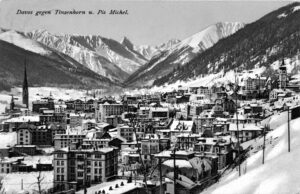
She looked at me for a reaction; I smiled and tried the potato salad.
“I learned the different coughs. The worse was the type of no conviction or relief. These were emitted by the dying. Then there was the dry cough and the loose one, which appeared healthier than the baying at the moon, barking croup kind.”
Laughing and spitting out a little potato salad, I covered my mouth and tried to control my mirth, while saying, “It sounds nice, the place, I mean.”
She smiled, “I guess describing coughs does sound funny. It was a pretty regular topic of discussion up there. The sanatorium was a splendid resort, but it didn’t seem right to spend my family’s money when I didn’t feel sick.”
“During the second winter it snowed nearly all the time. That can happen here too. Really, Davos-Dorf and Steamboat Springs are very much alike. The patients were grumbling. “Positivity recalcitrant,” they moaned. I didn’t mind a little snow during treatment. I pulled the feather filled schlafdecke up to my nose and watched the snow fall. Frequent deep breaths cleared and relaxed my mind, not only in the winter but anytime. I loved the tunnels and canyons of snow in the village. The roads were packed with teams of horses pulling rolling things filled with frozen water. Stairways of chopped snow lead down to the shops. It was an enchanting place year-round, but after 18 months I was looking for a way to get out. I hope I’m not boring you.”
“No, I find it interesting. Please continue,” I encouraged and shifted to face her. Her eyes were lovely.
“I read scores and scores of books and some twice, which was very enlightening since one does miss so much the first time. Anyway, in time I realized the staff would grant just about any request. I ordered a porter for breakfast and the sweet waitress in her starched black dress, white blouse and white apron apologized saying they only had German Altbier. In a few weeks, there was English porter anytime I wished. I asked for international newspapers and started receiving the news from Paris, London, New York and even Denver which was unexpected. I sent query letters for information about jobs advertised or locations I thought would be fun to visit. I always posted them in the village with a General Delivery return address. Somehow der Herr Doktor got wind of my many letters and accused me of being a terrible patient. He said,’ I would never get well and was a guileless fool.’ “
“I was going up in the electric lift to my room when I saw the ad in the Rocky Mountain News for schoolteachers in rural Steamboat Springs. I sent for more information. With the reply, I received a description of mountains, hot springs, dry climate and a metropolis of wealth and health. In addition, I was assured a teaching position because I was, in their words, ‘obviously a well-educated woman with international character.’”
“I persuaded my mum to encourage my stepfather to send me here. He would be saving money, which was a convincing argument. He agreed. I sent a letter to accept and received a glowing welcome to Steamboat Springs. They really wanted me. Now, it seems the postscript at the bottom of the letter was probably just an afterthought. It said, ‘Please bring references and previous employment dates.’”
Corina paused. She took a small, delicate bite of a strawberry; savored it and sighed, as if she was collecting her thoughts. “Julius, I lied to you when I told you I didn’t like teaching. The truth is, when they saw I had spent the last two years in a Swiss tuberculosis sanatorium, palpable fear showed in their eyes, and I wasn’t going to be teaching any children here. So, I work for the undertaker putting makeup on dead people… That’s pretty safe,” she blurted.
She started crying. I put my arm around her, hugged her and told her she appeared happy here. She smiled, gently touched her tears away with a linen hankie she pulled from a side pocket in her sweater. Her lunch forgotten, mine finished, I helped her pack the basket and then walked her home. We were pensive and spoke little most of the way. Then I asked if she would teach me to ski. “The first day it snows,” she replied and added, “Snowshoeing is fun too. By the way are you going to buy a bicycle?”
“I’ve been thinking about it and looked at some.”
“Good, we’ll take a ride together soon.” She opened her gate, sighed a little and then smiled. “Thanks for listening Julius and a good day to you. Why don’t you take in a baseball game or something? I’m taking to my bed for a while.”
I watched her walk into the house. Then went to the ball field, observed a game I knew nothing about and thought mostly about her. It rained twice and I never moved. Steamboat beat Craig 5 to 1. It is easy to be in love, but can I be faithful, forever?